Why Concrete Fails to Achieve Design Strength: Causes, Mechanisms and Technological Solutions.
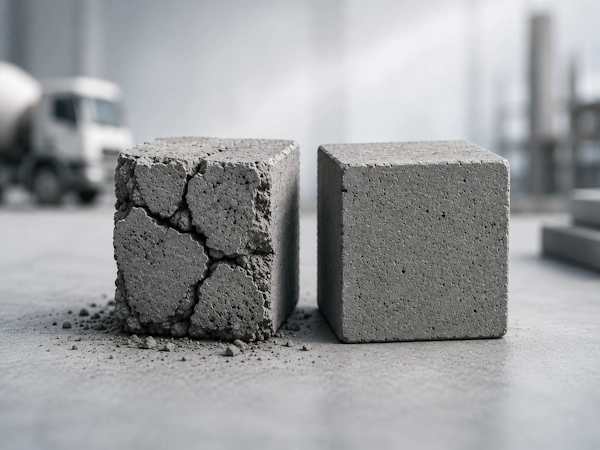
Expert overview of the causes, mechanisms and technological solutions.
A situation where concrete does not achieve its specified strength is one of the most critical issues in the production of concrete and reinforced concrete products, as well as in cast-in-place construction. It can lead to rejected products, excessive material consumption, production delays and potential structural risks.
In practice, the problem rarely has a single cause. In most cases, it is the result of a combination of factors: from an incorrect mix design to improper curing conditions. In this article, we will look at the mechanisms of concrete strength development, the main reasons for strength loss and effective technological solutions.
- What concrete strength really depends on
Concrete strength develops as a result of cement hydration — a chemical reaction between cement and water that forms calcium silicate hydrate phases (C-S-H), which create the structure of the cement stone.
The key factors that determine strength are:
- water-cement ratio (W/C);
- cement activity and composition;
- quality of aggregates;
- degree of compaction of the concrete mix;
- curing conditions (temperature and humidity);
- heat and moisture treatment regime (for reinforced concrete products);
- presence and effectiveness of chemical admixtures.
Excess water forms capillary porosity, which directly reduces strength. Insufficient water, or loss of water, limits cement hydration.
In modern concrete production, control of these parameters is increasingly supported by the use of specialised chemical admixtures, which help stabilise the hydration process and reduce the impact of raw material variations.
- How to understand that concrete is not reaching its specified strength
The main signs of the problem are:
- test results do not correspond to the specified concrete class;
- significant strength variations between batches;
- low early strength after 1–3 days;
- delayed strength gain after 7 or 28 days.
In production conditions, this often appears as unstable product quality, an increased number of rejected items or the need to correct the technological process after unsatisfactory test results have already been obtained.
- Main reasons why concrete does not gain strength
High water-cement ratio (W/C)
This is the most common reason for reduced concrete strength. An increase in W/C leads to higher capillary porosity, lower structural density and reduced final strength.
Even a slight increase in the water-cement ratio by 0.05–0.1 can significantly affect the result. For example, increasing W/C from 0.45 to 0.55 can reduce final concrete strength by 15–30%, depending on the mix composition, cement type and curing conditions.
In practice, an excessive W/C ratio is often connected with the need to increase the workability of the mix. That is why, in industrial production, plasticising admixtures are used instead of adding extra water, allowing workability to be maintained without loss of strength.
Low-quality or inconsistent cement
Problems with strength development may be caused by a reduction in cement activity during storage, an unstable mineralogical composition, or the use of different cement batches with varying characteristics. As a result, concrete may demonstrate different rates of strength gain even when the same mix design is used.
Problems with aggregates
Aggregates affect not only strength but also the rheology of the concrete mix. The presence of dust, clay particles, a high percentage of flaky aggregate particles, an improper grading curve or excessive water absorption can reduce adhesion and alter the actual water-cement ratio.
Absence or incorrect selection of admixtures
Chemical admixtures directly influence mix rheology, water demand and the rate of hydration. The absence of an effective plasticiser often results in excessive water consumption, while an incorrectly selected admixture can lead to unstable concrete properties.
This is particularly important for modern concretes with a low water-cement ratio, where even a slight variation in water content can significantly reduce strength, watertightness and long-term durability.
In concrete and precast reinforced concrete production, admixtures should always be selected with consideration for the specific raw materials and production technology being used. For example, MTC Concrete specialists tailor admixture solutions to the type of cement, aggregates and manufacturing conditions, helping to eliminate common strength-related issues.
Production process violations
Typical mistakes include adding water "by eye", insufficient or excessive mixing, and inaccuracies in dosing. These issues result in a non-uniform concrete mix and unstable performance characteristics of the hardened concrete.
Insufficient compaction of the concrete mix
The presence of entrapped air voids directly affects concrete strength. Insufficient or improper compaction leads to honeycombing, voids and areas of increased porosity within the structure.
The main consequences of insufficient compaction are:
- reduced concrete density;
- lower compressive strength;
- increased water absorption;
- reduced frost resistance;
- lower watertightness.
This issue is particularly critical in the production of reinforced concrete products, where the quality of compaction directly affects the performance and service life of the finished product.
Improper curing conditions
Temperature and humidity have a direct impact on cement hydration. Low temperatures slow down or stop hydration reactions, while excessively high temperatures may cause rapid hardening and the formation of a weaker microstructure. Freezing water within the concrete pores can damage the cement matrix at an early stage.
Inadequate concrete curing
Without proper curing, water evaporates rapidly, hydration slows down or stops, and the concrete develops a weaker structure. This is especially critical for exposed surfaces and for work carried out in hot or windy conditions.
It should be noted that strong winds alone can cause the formation of plastic shrinkage cracks due to accelerated evaporation of water from the concrete surface. Such defects can negatively affect the durability of the structure and require appropriate curing measures.
- Summary table: what concrete strength depends on
| Factor | Mechanism of influence | Consequence | Solution |
| High W/C ratio | Increased capillary porosity and reduced cement matrix density | Reduced strength, frost resistance and watertightness | Optimise W/C ratio and use plasticisers |
| Low-quality cement | Insufficient activity or unstable mineralogical composition | Unstable strength development and batch-to-batch variation | Supplier control and laboratory testing of cement |
| Contaminated aggregates | Reduced bond between cement matrix and aggregate particles | Lower density and reduced concrete strength | Control aggregate cleanliness and grading |
| Lack of effective admixtures | Higher water demand and unstable mix rheology | Reduced density and strength | Use properly selected plasticising and specialised admixtures |
| Insufficient compaction | Entrapped air voids remain within the concrete structure | Reduced strength, frost resistance and watertightness | Optimise vibration and compaction procedures |
| Improper curing conditions | Slowed or disrupted hydration process | Failure to achieve specified strength | Control temperature and humidity during curing |
| Poor concrete curing | Loss of moisture and premature interruption of hydration | Weak structure and surface cracking | Moist curing, covering and protection from sun and wind |
Moist curing, covering and protection from sun and wind
- How to increase concrete strength without increasing cement consumption
In most cases, higher concrete strength can be achieved not by increasing cement content, but by optimising the concrete structure.
Effective solutions include:
- optimising the water-cement ratio;
- using modern plasticisers and superplasticisers;
- controlling aggregate quality;
- stabilising the mix design;
- adjusting mixing, placing and compaction procedures;
- providing proper curing after placement.
The use of modern admixtures makes it possible to reduce the water-cement ratio without sacrificing workability, which is a key factor in improving concrete density and long-term durability.
In many cases, a properly selected superplasticiser can deliver higher strength without increasing cement consumption, positively affecting both the technical performance of the concrete and the overall economics of production.
- Why concrete fails to gain strength at low temperatures
As temperature decreases, cement hydration slows down, and when water freezes, the process effectively stops. Until concrete reaches a critical strength of approximately 3–5 MPa, it remains particularly vulnerable to freezing.
If water within the concrete pores freezes before a sufficient cement matrix has formed, its expansion creates internal stresses that lead to microcracking and irreversible strength loss.
Key solutions for concreting at low temperatures include:
- using antifreeze admixtures with accelerated setting properties;
- controlling the temperature of the concrete mix;
- thermal insulation of structures;
- steam curing;
- electric heating;
- observing appropriate waiting periods before formwork removal or loading.
In winter conditions, the correct selection of admixtures and curing regimes is critical. Mistakes made at this stage are extremely difficult, and often impossible, to correct once the concrete structure has developed.
- What to do if concrete is already failing to gain strength
If test results indicate insufficient strength development, it is important not to rely on assumptions but to carry out a comprehensive analysis of both the mix design and the production process.
A practical action plan:
- Check the actual water-cement ratio.
- Analyse cement quality and activity.
- Inspect aggregates for contamination, grading and water absorption.
- Verify dosing accuracy of all components.
- Review mixing, placing and compaction procedures.
- Assess curing conditions and concrete protection measures.
- Carry out trial mixes with adjustments to the mix design.
In most cases, an effective solution is identified through a series of controlled trial mixes combined with appropriate mix design modifications and admixture selection.
- Common mistakes when trying to increase concrete strength
The most common mistakes include:
- increasing cement content without adjusting the mix design;
- adding extra water to improve workability;
- using unsuitable admixtures;
- ignoring aggregate quality;
- failing to perform trial mixes before introducing a mix design into production.
Such actions often fail to solve the problem and instead increase production costs or reduce the consistency of concrete performance.
- How to ensure consistent concrete strength in production
Consistent results can only be achieved through a systematic approach. This requires raw material control, accurate dosing, mix optimisation, correct admixture selection and strict adherence to production procedures.
The key elements of stable quality are:
- incoming inspection of cement and aggregates;
- monitoring aggregate moisture content;
- automated and accurate batching of materials;
- regular laboratory testing of both fresh and hardened concrete;
- optimising mix designs for specific raw materials;
- using effective plasticising and specialised admixtures;
- maintaining correct curing conditions and procedures.
In most cases, insufficient strength is resolved through optimisation of the overall production process rather than by addressing a single factor in isolation.
Experience shows that technical support and admixture selection tailored to a specific production environment can not only solve strength-related issues but also significantly improve product consistency and quality stability.
- Conclusion
Insufficient concrete strength is not a random occurrence but the result of specific technological and production-related factors. Understanding hydration mechanisms and controlling key parameters make it possible not only to eliminate the problem but also to stabilise production.
A properly designed mix and the use of modern admixtures allow manufacturers to achieve predictable performance without unnecessary material consumption.
Controlling the water-cement ratio, ensuring raw material quality and using correctly selected chemical admixtures help not only to achieve the specified concrete strength but also to reduce production costs through cement optimisation, reduced waste and improved process stability.
If achieving consistent concrete quality and obtaining a solution tailored to your production conditions is important to you, contact the technical team at MTC Concrete. Our specialists can help you select effective admixtures and optimise your mix design for specific production requirements.
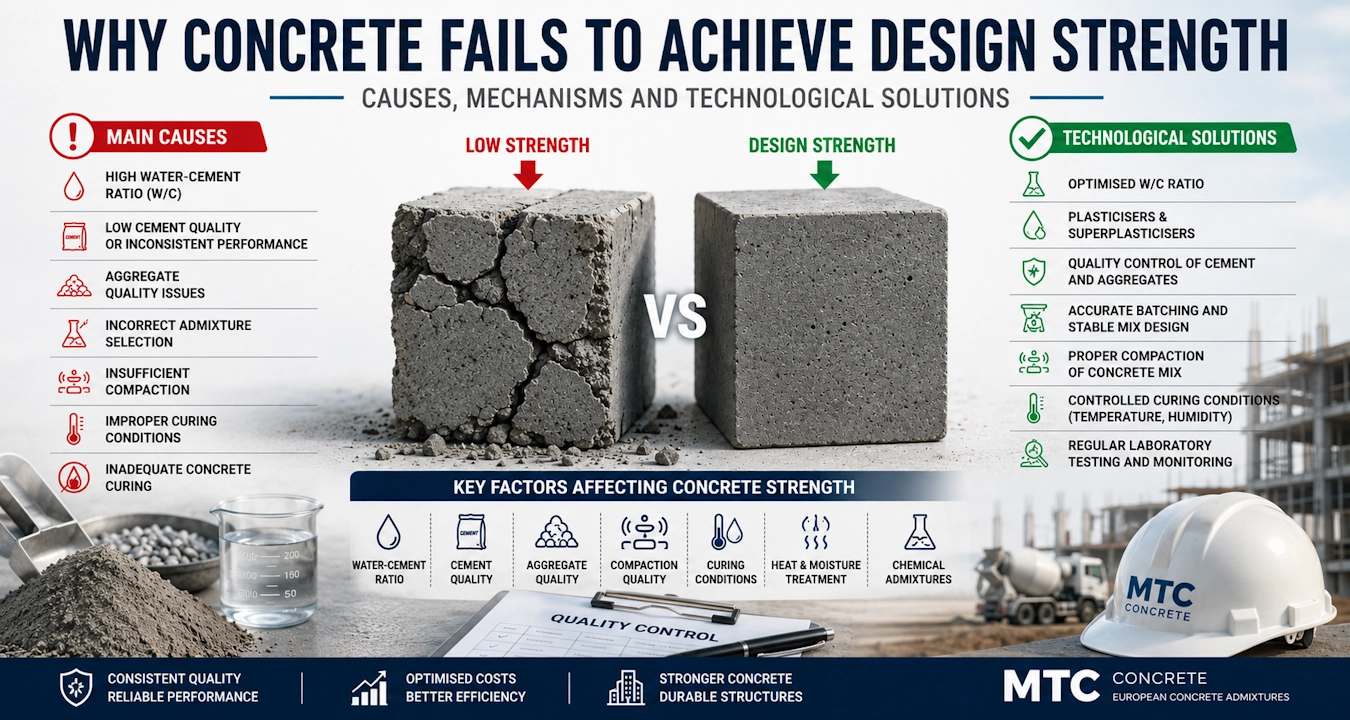
Infographic: Main Causes of Insufficient Concrete Strength and How to Prevent Them
This infographic summarises the key factors affecting concrete strength development, including the water-cement ratio, cement and aggregate quality, mix compaction, curing conditions, concrete curing practices and the use of chemical admixtures. It also highlights the main technological solutions that help ensure consistent concrete quality and achieve the specified strength requirements.